According to recent news, a recent investigation by Yunnan Tea Business Association and Pu-erh County reveals that Guang Zhou Tea Market is full of faked Pu-erh. Yuntong Ding, vice president of Yunnan Tea Business Association, even believes that most of Pu-erh that local consumers bought in Guang Zhou is faked. According to Yuntong Ding, most Pu-erh sold in Guang Zhou is from Meng Hai and Pu-erh areas. Annual Pu-erh production of these two areas is only 3,000 tons. Given that the Southern Market sells 30,000 -40,000 tons of Pu-erh per year, it is obvious that most of Pu-erh sold there is faked. Weizhen He, vice president of Guang Zhou Tea Industry Association, admitted that there are faked Pu-erh in Guang Zhou, but disagreed with the numbers. Yunnan is applying for “Pu-erh Tea” mark similar to what Zhe Jiang did to protect Long Jing tea.
Tea Lovers at JinYuXuan Tea House
www.teahub.com
Tags: Tea, Pu-erh
Sunday, September 11, 2005
Sunday, August 14, 2005
Things You Need to Know Before Starting Your Pu-erh Collection
With Pu-erh gaining mainstream attention outside of Chinese community, many western tea drinkers start to love this mysterious tea. The high prices that some well aged Pu-erh demand and the hyper about collecting Pu-erh as an investment have pumped many western Pu-erh drinkers into collecting Pu-erh. However, before you spend your hard earned money on this investment, you need to know more about Pu-erh. Simply put, not all Pu-erh that produced nowadays are worth collecting.
First of all, those famous Pu-erh factories are no longer your quality assurance. A good example is Meng Hai Tea Factory’s 2004 production. The company was struggled with funding problem and could not afford good raw materials. As a result of that, most of the company’s 2004 productions were of poor quality. Many Pu-erh collectors shunned away from those products.
Secondly, vast amount of faked brand name products can even deceive professionals’ eyes. In a recent online discussion on Xia Guan Te Ji Tuo Cha, many people voted the faked one as the real one! That is a very disturbing fact! Without carefully examing, can you tell the differences between the real and faked ones from pictures from two Xia Guan Te Ji Tuo Cha wraps?
Thirdly, with many new tea factories evolving now, factories are introducing many untraditional Pu-erh to the market as an answer to the severe competitions. Unfortunately, some of those newly introduced Pu-erh have started to show that they can not stand the test of time. One good example is the young green Pu-erh that is made of only tea buds. This type of Pu-erh can not last long time aging. Therefore, is not suitable for collection.
When making Pu-erh collection decisions, tea leave quality should be your first consideration, followed by recipe and production techniques.
Linda
www.teahub.com
Tags: Tea, Pu-erh
First of all, those famous Pu-erh factories are no longer your quality assurance. A good example is Meng Hai Tea Factory’s 2004 production. The company was struggled with funding problem and could not afford good raw materials. As a result of that, most of the company’s 2004 productions were of poor quality. Many Pu-erh collectors shunned away from those products.
Secondly, vast amount of faked brand name products can even deceive professionals’ eyes. In a recent online discussion on Xia Guan Te Ji Tuo Cha, many people voted the faked one as the real one! That is a very disturbing fact! Without carefully examing, can you tell the differences between the real and faked ones from pictures from two Xia Guan Te Ji Tuo Cha wraps?

Thirdly, with many new tea factories evolving now, factories are introducing many untraditional Pu-erh to the market as an answer to the severe competitions. Unfortunately, some of those newly introduced Pu-erh have started to show that they can not stand the test of time. One good example is the young green Pu-erh that is made of only tea buds. This type of Pu-erh can not last long time aging. Therefore, is not suitable for collection.
When making Pu-erh collection decisions, tea leave quality should be your first consideration, followed by recipe and production techniques.
Linda
www.teahub.com
Tags: Tea, Pu-erh
Sunday, June 26, 2005
Talks about Zi Sha Teapot3
All of our Zi Sha teapots are 100% hand made. Unlike those mass production teapots, every hand made teapot is unique. No two hand made teapots are identical. This definitely adds the attractiveness to a teapot. How do you tell if your teapots are 100% hand made? A quick exam of the inside of a teapot can answer this question. A 100% hand made teapot only has one unobvious connection line at the joint spot of handle and body. A mold made teapot on the other hand has two connection lines. One is at the joint spot of mouth and body, the other one is at the joint spot of handle and body.
There are plenty of articles discussing things like lid tightness, water flow, etc. We will not repeat those discussions here. Enjoy your tea and teapots!
Tea Lovers at JinYuXuan Tea House
www.teahub.com
There are plenty of articles discussing things like lid tightness, water flow, etc. We will not repeat those discussions here. Enjoy your tea and teapots!
Tea Lovers at JinYuXuan Tea House
www.teahub.com
Monday, June 13, 2005
Talks about Zi Sha Teapot 2
We now know that high quality clay is very important to the final quality of a Zi Sha teapot. But how do you as a final consumer know that your teapot is made of high quality clay? In general, a Zi Sha teapot made of good quality clay has soft and elegant color that catches your eyes. If a teapot looks either dull or abnormally shiny, which generally suggests that the teapot may be polished, then this teapot is very likely made of low quality clays.
When you lightly knock your teapot body or handle with your teapot cap, the sound that the hit can also reveal the quality of the clay. If it is a crispy sound, the teapot is made of ordinary quality clay with right firing temperature. If it is a metallic sound, the teapot is made of good quality clay. On the other hand, A dull sound suggests either low quality clay or low firing temperature – neither of them is desirable. A teapot with pleasant steel sound that echoes is made of high quality clay and has been used for many years – highly desirable.
So, do you know how to judge your clay quality now? Next time, we will discuss how to judge if a teapot is hand-crafted.
Tea Lovers at JinYuXuan Tea House
www.teahub.com
When you lightly knock your teapot body or handle with your teapot cap, the sound that the hit can also reveal the quality of the clay. If it is a crispy sound, the teapot is made of ordinary quality clay with right firing temperature. If it is a metallic sound, the teapot is made of good quality clay. On the other hand, A dull sound suggests either low quality clay or low firing temperature – neither of them is desirable. A teapot with pleasant steel sound that echoes is made of high quality clay and has been used for many years – highly desirable.
So, do you know how to judge your clay quality now? Next time, we will discuss how to judge if a teapot is hand-crafted.
Tea Lovers at JinYuXuan Tea House
www.teahub.com
Saturday, June 04, 2005
Talks about Zi Sha Teapot
We received many emails from customers who purchased Zi Sha teapots from us expressing their excitements about their orders. Unlike many other shops, we focus on functionality instead of fancy style of our teapots. Most of our teapots are in basic traditional styles. So what about those teapots that impressed our happy customers? It is their fine craftsmanship and high quality clay.
Seasoned tea drinkers and Zi Sha teapot collectors know that high quality clay is very important to the overall quality of a teapot. Other than the quality of raw clay, skill level of a craftsman also affects final teapot clay quality. How are the two associated?
As many of us may already know, Zi Sha teapot is a general name for all teapots that made of Zi Sha clay. Zi Sha clay can be further divided into Zi (purple) clay, Zhu (red) clay and Ben Shan Lu (green) clay. Zi Sha clay is a hard mineral. Mined Zi Sha clay will change into tiny soy bean size sands after being exposed to sun light and rain. After further processing, those sands turn into wet clay, or what known as raw clay. Raw clay will need to be aged before it can be used for making teapots. Well aged clay demands high prices.
The time that a craftsman starts to make a teapot from raw clay is when craftsmanship comes into play in the final quality of teapot clay. An experienced craftsman has good clay processing skills and is good at controlling firing temperature.
We will talk about how to judge Zi Sha teapot clay quality next time….
Tea Lovers at JinYuXuan Tea House
www.teahub.com
Seasoned tea drinkers and Zi Sha teapot collectors know that high quality clay is very important to the overall quality of a teapot. Other than the quality of raw clay, skill level of a craftsman also affects final teapot clay quality. How are the two associated?
As many of us may already know, Zi Sha teapot is a general name for all teapots that made of Zi Sha clay. Zi Sha clay can be further divided into Zi (purple) clay, Zhu (red) clay and Ben Shan Lu (green) clay. Zi Sha clay is a hard mineral. Mined Zi Sha clay will change into tiny soy bean size sands after being exposed to sun light and rain. After further processing, those sands turn into wet clay, or what known as raw clay. Raw clay will need to be aged before it can be used for making teapots. Well aged clay demands high prices.
The time that a craftsman starts to make a teapot from raw clay is when craftsmanship comes into play in the final quality of teapot clay. An experienced craftsman has good clay processing skills and is good at controlling firing temperature.
We will talk about how to judge Zi Sha teapot clay quality next time….
Tea Lovers at JinYuXuan Tea House
www.teahub.com
Wednesday, April 20, 2005
Making Oolong Ice Tea
We mentioned this special Oolong cold brewing method in our Hello Li Jiang blog. Here is the detailed brewing method:
Add 10-15g Oolong tea into a 1L teapot, and then add small amount of lukewarm boiled water to warm up the tea leaves. Throw away the warm water, and then quickly pour cold water into the teapot to full. Store the teapot in refrigerator for 4 hours then serve. One beauty of this brewing method is that you can still brew the tea leaves with hot water after brewing them for 3 times using cold water!
Tea Lovers at JinYuXuan Tea House
www.teahub.com
Add 10-15g Oolong tea into a 1L teapot, and then add small amount of lukewarm boiled water to warm up the tea leaves. Throw away the warm water, and then quickly pour cold water into the teapot to full. Store the teapot in refrigerator for 4 hours then serve. One beauty of this brewing method is that you can still brew the tea leaves with hot water after brewing them for 3 times using cold water!
Tea Lovers at JinYuXuan Tea House
www.teahub.com
Saturday, April 02, 2005
2005 Long Jing arrived in BeiJing with minimum price of RMB2800 per 500g
Star Daily March 31 news said that first batch of 2005 Long Jing arrived in Beijing by flight in the morning. This batch of Long Jing was produced on March 30th. Due to limited supplies, only 2.5kg of high price Long Jing (RMB5800 per 500g), and 10kg of moderate price Long Jing (RMB2800 per 500g) are available.
Tea Lovers at JinYuXuan Tea House
www.teahub.com
Tea Lovers at JinYuXuan Tea House
www.teahub.com
Friday, April 01, 2005
Updates on 2005 West Lake Long Jing
According to news from ZJSR on March 28, local farmer and business man have confirmed that harvest of this year’s Shi (Shi Feng) Long Jing has not started. The scheduled harvest time for Shi Feng Long Jing is after April 3rd. The tea business man also said that Long Long Jing had not been available on market yet.
Mei (Mei Jia Wu) Long Jing started harvest earlier. A local business man confirmed that only a total of 4.6kg was produced after the first 3 days of the harvest. And all of them have been counted for. People paid RMB2,800 per 500g for these Mei Long Jing.
Tea Lovers at JinYuXuan Tea House
www.teahub.com
Mei (Mei Jia Wu) Long Jing started harvest earlier. A local business man confirmed that only a total of 4.6kg was produced after the first 3 days of the harvest. And all of them have been counted for. People paid RMB2,800 per 500g for these Mei Long Jing.
Tea Lovers at JinYuXuan Tea House
www.teahub.com
Monday, March 28, 2005
Dong Ting Bi Luo Chun Started 2005 Spring Harvest
According to XHBY, farmers in East Mountain and West Mountain of Dong Ting started to pluck 2005 Spring Bi Luo Chun last week. Due to this year’s cold weather, this year’s Bi Luo Chun harvest was delayed for more than a week. As a result of that, availability of large quantities of authentic Dong Ting Bi Luo Chun would be delayed for another 7 to 8 days. People expect this year’s Bi Luo Chun production will be lower than that of last year.
Tea Lovers at JinYuXuan Tea House
www.teahub.com
Tea Lovers at JinYuXuan Tea House
www.teahub.com
West Lake Long Jing Will Be Available in Next few Days
According to Hang Zhou Daily, due to this Spring’s cold weather, West Lake Long Jing harvest was delayed this year. Farmer Zhu said that based on his experience, small quantity of authentic West Lake Long Jing would be available by March 28. However, people would have to wait for 2 more days for larger quantities of 5kg or more. Low production of high quality tea leaves will cause this year’s authentic West Lake Long Jing price to be much higher than that of last year.
Tea Lovers at JinYuXuan Tea House
www.teahub.com
Tea Lovers at JinYuXuan Tea House
www.teahub.com
Sunday, February 27, 2005
Dai Nationality Bamboo Tea
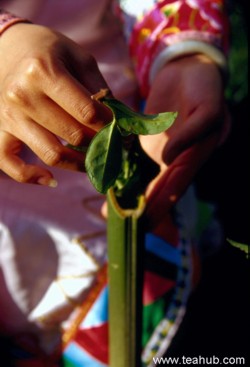
Bamboo tea is a Dai Nationality ethnic tea. There are two ways to make the bamboo tea. One way is to fill processed (killing out and kneading and rolling) young tea leaves (one bud and two and three leaves) into a bamboo tube, and bake it on fire. The other way is to steam sun-dried tea leaves on top of sticky rice for 15 minutes, then fill tea leaves into a bamboo tube. Bake the tube while filling and compressing leaves into it. After the tube is full, seal the tube with bamboo leaves and bake it on fire. Turn the tube every 5 minutes till the tube turns into yellowish color and the leaves inside it are dry. Cut open the tube, and the bamboo tea is done.
When drink bamboo tea, add small amount tea leaves into a bowl, brew them with boiling water for 5 minutes, and the tea is ready for drinking. Bamboo tea has yellowish green tea liquor, pleasant aroma, and refreshing taste. Dai people use bamboo tea to serve guests.
Tea Lovers at JinYuXuan Tea House
www.teahub.com
Saturday, January 29, 2005
Talks about Black (Shou/Ripe) Pu-erh (2)
This may be one of the most interesting topics to many Pu-erh Lovers – How is Wo Dui conducted?
In massive Wo Dui production, loose Mao Cha are first piled up into 1-1.5m high piles, then spilled on water and covered with wet cloths. This is called Wo Dui. The tea piles need to be turned over (Fan Dui) on the second day, and then piled up again. After that, the tea piles still need to be turned over a few more times. Humidity and temperature are keys to the success during this Fan Dui process. Fan Dui process decides quality of Wo Dui processed Pu-erh. This process may take 30-40 days. When tea leaves turn into brownish red color, it is time to set the leaves naturally dried with good air flow. After leave water content reduces to below 14%, the leaves are ready for further process.
Tastes of Wo Dui processed Pu-erh will improve with aging. They can be later compressed into different shapes. Producers sometimes also mix up Wo Dui processed Pu-erh and new Mao Cha to create mixed compress Pu-erh.
As you can see, Wo Dui is a highly scientific process. Those cheap wet storage tricks are no way close to it.
Tea Lovers at JinYuXuan Tea House
www.teahub.com
In massive Wo Dui production, loose Mao Cha are first piled up into 1-1.5m high piles, then spilled on water and covered with wet cloths. This is called Wo Dui. The tea piles need to be turned over (Fan Dui) on the second day, and then piled up again. After that, the tea piles still need to be turned over a few more times. Humidity and temperature are keys to the success during this Fan Dui process. Fan Dui process decides quality of Wo Dui processed Pu-erh. This process may take 30-40 days. When tea leaves turn into brownish red color, it is time to set the leaves naturally dried with good air flow. After leave water content reduces to below 14%, the leaves are ready for further process.
Tastes of Wo Dui processed Pu-erh will improve with aging. They can be later compressed into different shapes. Producers sometimes also mix up Wo Dui processed Pu-erh and new Mao Cha to create mixed compress Pu-erh.
As you can see, Wo Dui is a highly scientific process. Those cheap wet storage tricks are no way close to it.
Tea Lovers at JinYuXuan Tea House
www.teahub.com
Sunday, January 23, 2005
Talks about Black (Shou/Ripe) Pu-erh (1)
There are many black Pu-erh in the market. Some are Wo Dui processed and some are wet stored (we do not recommend drinking this type of Pu-erh). Wet stored Pu-erh tastes horrible and makes some first time Pu-erh drinkers believe that Pu-erh is a terrible tea. Although we have discussed the difference between Wo Dui Pu-erh and Wet Storage Pu-erh in our We Reveal the Mystery of Pu-erh page, we feel the need to discuss this topic even further.
When Wo Dui technique was first introduced?
The general consensus is that Kunming Tea Factory first started Pu-erh speedy aging technique research in 1973. According to Qiying Wu, former president of Kunming Tea Factory, 1975 was the first year that Wo Dui technique was used in massive production.
What is Wo Dui technique?
Wo Dui technique only applies to loose black Pu-erh production. Compressed Pu-erh are later processed using Wo Dui processed loose black Pu-erh. Afer a pu-erh is compressed, the only way to speed up its aging is through wet storage. Ways like cave storage are types of wet storage.
We will discuss how Wo Dui is conducted next time.
Tea Lovers from JinYuXuan Tea House
www.teahub.com
When Wo Dui technique was first introduced?
The general consensus is that Kunming Tea Factory first started Pu-erh speedy aging technique research in 1973. According to Qiying Wu, former president of Kunming Tea Factory, 1975 was the first year that Wo Dui technique was used in massive production.
What is Wo Dui technique?
Wo Dui technique only applies to loose black Pu-erh production. Compressed Pu-erh are later processed using Wo Dui processed loose black Pu-erh. Afer a pu-erh is compressed, the only way to speed up its aging is through wet storage. Ways like cave storage are types of wet storage.
We will discuss how Wo Dui is conducted next time.
Tea Lovers from JinYuXuan Tea House
www.teahub.com
Monday, December 27, 2004
Tie Guan Yin is a type of Oolong tea
When one of my friends told me “I like Tie Guan Yin and Oolong tea”, I knew that he was one of those confused by many tea names floating around. I quickly explained to him that Tie Guan Yin was in deed a type of Oolong tea.
Based production region, Oolong can be devided into four categories:
Oolong from South FuJian. The most famous one is AnXi Tie Guan Yin. One thing that needs to be pointed out is that while Tie Guan Yin means oolong teas made of leaves from Tie Guan Yin tree in AnXi, Tie Guan Yin only means oolong teas processed with the Tie Guan Yin technique in Taiwan.
Oolong from North of FuJian. The most famous one is WuYi rock tea. Da Hong Pao, Xiao Hong Pao, Rou Gui are all WuYi rock teas.
Oolong from Guang Dong. The most famous one is Feng Huang Dan Cong. Feng Huang Shui Xian is a popular tea among Cantonese tea drinkers.
Oolong from Taiwan. Oriental Beauty, Dong Ding Oolong are all famous examples of Taiwan Oolong.
Based production region, Oolong can be devided into four categories:
Oolong from South FuJian. The most famous one is AnXi Tie Guan Yin. One thing that needs to be pointed out is that while Tie Guan Yin means oolong teas made of leaves from Tie Guan Yin tree in AnXi, Tie Guan Yin only means oolong teas processed with the Tie Guan Yin technique in Taiwan.
Oolong from North of FuJian. The most famous one is WuYi rock tea. Da Hong Pao, Xiao Hong Pao, Rou Gui are all WuYi rock teas.
Oolong from Guang Dong. The most famous one is Feng Huang Dan Cong. Feng Huang Shui Xian is a popular tea among Cantonese tea drinkers.
Oolong from Taiwan. Oriental Beauty, Dong Ding Oolong are all famous examples of Taiwan Oolong.
More talks regarding Oolong tea can be found at our Oolong Talk .
Sunday, December 19, 2004
Experts proved from genetic toxicity test that Pu-erh was fairly safe to drink
Recent news from the First Yunnan Pu-erh Tea International Forum reported a genetic toxicity test conducted by Professor Qingjin Liu of Tea Research Institute at Southwest Agriculture University. Professor Liu and his colleagues analyzed 1 year, 5 year and 10 year Pu-erh samples from representative tea factories, and concluded that Pu-erh made by regular tea factories was fairly safe to drink. Professor Liu and team analyzed three Pu-erh samples and one baked green tea sample, and none of them showed mutagenicity to prokaryotic cell, eukaryotic cell, and reproduction cell.
Tea Lovers at JinYuXuan Tea House
www.teahub.com
Tea Lovers at JinYuXuan Tea House
www.teahub.com
Monday, December 13, 2004
Majority of Long Jing and Bi Luo Chun are from Si Chuan
Recent news from ChengDu Business Paper said that 80% Long Jing (from Zhe Jiang), Bi Luo Chun (from Jiang Su) on the market are actually from Si Chuan. According to the news, unethical business people purchase Si Chuan teas at low prices and sell them as Long Jing or Bi Luo Chun at 3 to 4 times the paid prices.
An expert told the reporter that appearance of real Long Jing and Si Chuan tea, Zhu Ye Qing, are quite similar. It is very hard for regular people to tell the differences. Experts from Tea Research Institute also said that Long Jing demanded high prices while its production was low. Therefore, some business people produce Si Chuan Long Jing to make high profits.
For real tastes of authentic Long Jing and Bi Luo Chun, check out our selections. More talks and videos regarding Long Jing and Bi Luo Chun can be found at our Green Tea Talk .
More from our blog: Reading Long Jing Tea Leaves - learn to identify faked Long Jing.
Tea Lovers at TeaHub
www.teahub.com
An expert told the reporter that appearance of real Long Jing and Si Chuan tea, Zhu Ye Qing, are quite similar. It is very hard for regular people to tell the differences. Experts from Tea Research Institute also said that Long Jing demanded high prices while its production was low. Therefore, some business people produce Si Chuan Long Jing to make high profits.
For real tastes of authentic Long Jing and Bi Luo Chun, check out our selections. More talks and videos regarding Long Jing and Bi Luo Chun can be found at our Green Tea Talk .
More from our blog: Reading Long Jing Tea Leaves - learn to identify faked Long Jing.
Tea Lovers at TeaHub
www.teahub.com


Sunday, December 05, 2004
How to brew green tea?
Chinese people have developed many different green tea brewing methods. Based on leave adding timing, the methods can be divided into three categories: upper adding, middle adding and bottom adding.
Upper Adding: Pour hot water into a teaware to full first, and then add tea leaves. This method is suitable for teas like Bi Luo Chun. See our special brewing method for Bi Luo Chun.
Middle Adding: Pour hot water into a teaware to 1/3 full, add tea leaves and brew for awhile, and then fill up the teaware. This method is suitable for teas like Huang Shan Mao Feng.
Bottom Adding: Add tea leaves to a teaware first, and then pour hot water into the teaware. For best results, you may add high temperature hot water to ¼ to 1/3 full, let the tea leaves brew for awhile, and then add lower temperature hot water to ¾ or full. This is a very common brewing method and can be used for all green teas. Teas like Long Jing are recommended to be brewed with this method.
Glass, tea cup, teapot can all be used to brew green tea. For high quality teas, glass is better as it allows you to observe the nice leave presentations. As many people know, green tea should be brewed with water with comparatively lower temperature.
Please check out brewing instructions we developed for each individual of our green teas on our site at www.teahub.com/greentea.htm.
Tea Lovers at JinYuXuan Tea House
www.teahub.com
Upper Adding: Pour hot water into a teaware to full first, and then add tea leaves. This method is suitable for teas like Bi Luo Chun. See our special brewing method for Bi Luo Chun.
Middle Adding: Pour hot water into a teaware to 1/3 full, add tea leaves and brew for awhile, and then fill up the teaware. This method is suitable for teas like Huang Shan Mao Feng.
Bottom Adding: Add tea leaves to a teaware first, and then pour hot water into the teaware. For best results, you may add high temperature hot water to ¼ to 1/3 full, let the tea leaves brew for awhile, and then add lower temperature hot water to ¾ or full. This is a very common brewing method and can be used for all green teas. Teas like Long Jing are recommended to be brewed with this method.
Glass, tea cup, teapot can all be used to brew green tea. For high quality teas, glass is better as it allows you to observe the nice leave presentations. As many people know, green tea should be brewed with water with comparatively lower temperature.
Please check out brewing instructions we developed for each individual of our green teas on our site at www.teahub.com/greentea.htm.
Tea Lovers at JinYuXuan Tea House
www.teahub.com
Sunday, November 28, 2004
How to choose a right teapot for brewing Pu-erh?
As we discussed in our We Reveal the Mystery of Pu-erh, you should look for thick wall rough clay, round belly purple clay teapots. Thick wall rough clay will help to absorb some impure tastes of Pu-erh, while round belly will allow Pu-erh large leaves to expand. You should also make sure that water can be poured out quickly. This function requirement is quite often neglected.
When choosing a purple clay teapot for brewing tea, stick to the fundamentals. Your money should be spent on functionality, quality of clay, and excellence in craftsmanship. Do not over pay only because it carries a famous craftsman’s seal. Other than the fact that there are many faked seals out there, quite often products of famous craftsmen’s students also carry famous craftsmen’s seal. One reason that people seek famous craftsmen’s products is that they care about the quality of clay and they normally have access to high quality clays. Well aged clays are highly sought after and demand high prices. Therefore, if you stick to the fundamentals, your money will be well spent.
There are two types of purple clay teapots. One is for display, and the other one is for brewing tea. Although many famous craftsmen manage to find a balance between the two, some teapots are just too fancy and lose their function for brewing a good cup of tea. If you search some reputable tea retailers’ site that also sell purple clay teapots, you will notice that those demand high prices are those stick to basic design but shows high quality of clay and excellent attention to details.
Do your research, and you will find a purple clay teapot that serves you and your tea well.
Tea Lovers at JinYuXuan Tea House
www.teahub.com
When choosing a purple clay teapot for brewing tea, stick to the fundamentals. Your money should be spent on functionality, quality of clay, and excellence in craftsmanship. Do not over pay only because it carries a famous craftsman’s seal. Other than the fact that there are many faked seals out there, quite often products of famous craftsmen’s students also carry famous craftsmen’s seal. One reason that people seek famous craftsmen’s products is that they care about the quality of clay and they normally have access to high quality clays. Well aged clays are highly sought after and demand high prices. Therefore, if you stick to the fundamentals, your money will be well spent.
There are two types of purple clay teapots. One is for display, and the other one is for brewing tea. Although many famous craftsmen manage to find a balance between the two, some teapots are just too fancy and lose their function for brewing a good cup of tea. If you search some reputable tea retailers’ site that also sell purple clay teapots, you will notice that those demand high prices are those stick to basic design but shows high quality of clay and excellent attention to details.

Do your research, and you will find a purple clay teapot that serves you and your tea well.
Tea Lovers at JinYuXuan Tea House
www.teahub.com
Saturday, November 20, 2004
Do you know the difference between brewing tea for testing vs. for tasting?
The purpose of brewing tea for testing is to bring out all the bad aspects of tea. The purpose of brewing tea for tasting, on the other hand, is to avoid all the bad aspects of tea. As you can see, the two actually serve completely opposite purposes.
When brewing tea for testing, we normally use hot boiling water to brew tea for 5 minutes in a covered teaware. This will bring out all the bad tastes and smells of tea. When brewing tea for tasting, a seasoned tea master knows how to brew a tasty cup of tea by adjusting water temperature and brewing time based on characteristics of individual tea. For examples of various tea tasting brewing methods, please visit our site at www.teahub.com. The brewing instructions for our teas are carefully developed by our house tea master, Ms. Di Liu, the first Tea Ceremony Artificer in China, which is ranked higher than the title of Senior Tea Master.
Tea Lovers at JinYuXuan Tea House
www.teahub.com
When brewing tea for testing, we normally use hot boiling water to brew tea for 5 minutes in a covered teaware. This will bring out all the bad tastes and smells of tea. When brewing tea for tasting, a seasoned tea master knows how to brew a tasty cup of tea by adjusting water temperature and brewing time based on characteristics of individual tea. For examples of various tea tasting brewing methods, please visit our site at www.teahub.com. The brewing instructions for our teas are carefully developed by our house tea master, Ms. Di Liu, the first Tea Ceremony Artificer in China, which is ranked higher than the title of Senior Tea Master.
Tea Lovers at JinYuXuan Tea House
www.teahub.com
Saturday, November 13, 2004
Do you have the right water for brewing tea?

Many people know that the quality of tea leaves is very important for brewing a good cup of tea. However, not many people realize that the water that they use to brew tea is as important, if not more important, for brewing a good cup of tea. Mr. Zhang Dafu of Ming dynasty wrote in his Mei Hua Cao Tang Bi Tan that “Tea leaves need water to be brewed into a good cup of tea. 100% quality water can brew 80% quality tea leaves into a 100% quality cup of tea. On the other hand, 80% quality water can only brew 100% quality tea leaves into an 80% quality cup of tea.”
Lu Yu had detail discussions about tea brewing water in his famous tea book Cha Jing (Tea Bible). Generally speaking, hard water is not good for brewing tea. Water with PH value of greater than 7 may darken color of tea liquor and lighten taste of tea.
After selecting the right type of water, boiling water is the next important step. Cai Xiang of Song dynasty said in his tea book Cha Lu that “To boil water is the most difficult task. Foams will show up if water is not ready. Leaves will fell to bottom if water is over boiled…” When boiling water for brewing tea, people should use high heat to bring the water to rapid boiling. Over boiled water is not suitable for brewing tea.
Tea Lovers at JinYuXuan Tea House
www.teahub.com
Subscribe to:
Posts (Atom)